The Architecture of Wealth

Why lending, real estate, and structure are not three subjects — but one discipline
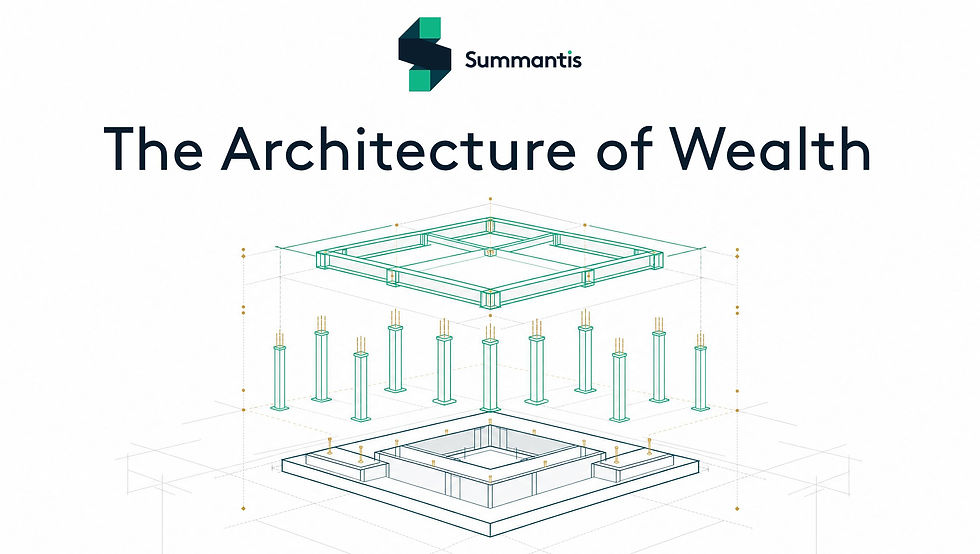
Most people are taught to keep three conversations separate. There is the lending conversation — interest rates, credit, qualifying, what a bank will approve. There is the real estate conversation — location, price, appreciation, what a property is worth. And there is the wealth conversation — saving, planning, protecting, passing things down. Three advisors, three vocabularies, three appointments that never speak to one another.
The people who build lasting wealth do not think this way. They understand something the separated model hides: lending, real estate, and structure are not three subjects. They are one discipline, and that discipline has a name. It is architecture.
At Summantis, this is the idea that organizes everything we do. Wealth is not accumulated by accident or grown by intensity. It is designed — the way a building is designed — by someone who understands how the parts carry the weight, how load moves through the frame, and how a structure built correctly can stand for generations. This article lays out that view: what wealth architecture is, why the three disciplines are actually one, and why treating them separately quietly costs people the outcomes they are working toward.
Lending is not borrowing. It is designed access to capital.
Begin with the piece most people misunderstand the most. Lending is not what you do when you run out of your own money. Lending is the deliberate use of other people’s capital to do things your own capital could never do alone.
The ordinary view treats debt as a burden and a loan as a last resort — something to minimize, pay off, and be ashamed of. The architectural view treats access to capital as a tool, and the terms of that access as design choices. What is the rate, the structure, the timeline, the collateral, the covenants? These are not fine print. They are the specifications that determine what you can build.
Two people can look at the same opportunity with the same amount of cash. One asks, “Can I afford this?” The other asks, “How should this be capitalized?” The first question limits you to what you already have. The second question opens the far larger world of what you can responsibly command. The difference between those two questions is the difference between a buyer and an architect.
Real estate is not property. It is a capital instrument.
Now the second piece. Most people buy real estate as a thing — a house, a building, a lot. Something you own, live in, or rent out. That framing is not wrong, but it is incomplete, and the incompleteness is expensive.
In the architectural view, a piece of real estate is not merely a place. It is an instrument — a device that does financial work. It holds value. It produces income. It serves as collateral that unlocks capital elsewhere. It converts one form of wealth into another. A single property, understood correctly, is simultaneously an asset you hold, an engine that generates cash, and a key that opens the door to the next acquisition.
This is why sophisticated investors rarely talk about a property in isolation. They talk about what it does inside a larger system — how its equity can be put to work, how its income supports additional capital, how it connects to the holdings around it. The building is real, but its power is relational. It matters because of what it lets you do next.
Structure is not paperwork. It is the frame that carries the weight.
The third piece is the one almost everyone ignores until it is too late. Structure — how you own what you own — is not administrative overhead. It is the frame the entire building hangs on.
Most people hold assets the simplest way possible: in their own name, tangled together, one problem away from touching everything. The architectural view treats ownership as a design decision with real consequences. Which entity holds which asset. How those entities relate. Where capital pools and how it moves. How the whole arrangement is governed and how it passes to the people who come after.
Structure is what turns a collection of assets into a system. It is the difference between owning several things and operating a coordinated whole. And like the frame of a building, you cannot easily add it after the fact. Retrofitting structure onto tangled assets is far harder, and far more costly, than designing it in from the start. This is why the people who think architecturally think about structure first — not last, and never as an afterthought.
Why the three are one discipline
Here is the point the separated model cannot see: these three are not adjacent subjects that occasionally interact. They are three faces of a single decision.
Consider how they move together. Access to capital determines what real estate you can command. The real estate you hold determines the capital you can access next. And the structure you own it through determines whether that capital and that property compound into a system or scatter into a pile. Change one, and the other two change with it. Lending terms shape which properties make sense. A property’s structure shapes what lending it can support. You cannot optimize one while ignoring the others — or rather, you can, and the result is the quiet underperformance that most people mistake for the normal ceiling of what is possible.
This is precisely where the separated model fails. When your lender does not know your real estate strategy, when your real estate advisor does not understand your capital position, and when no one is thinking about structure at all, every decision is made with two-thirds of the picture missing. Good individual choices add up to an incoherent whole. The building goes up, but no one designed it, and it shows.
Wealth architecture is the discipline of designing all three together — capital, property, and structure — as a single coordinated system. Not three appointments. One blueprint.
The Summantis view
This is the conviction Summantis is built on. The most important financial decisions people make are not really about picking the right loan, or the right property, or the right entity. They are about how those pieces are designed to work together. That is a question of architecture, and architecture is a discipline you can learn, apply, and get right.
We believe the separated model has cost too many capable people the outcomes their effort deserved — not because they made bad decisions, but because they made isolated ones. Bring the three disciplines into a single conversation, and the whole equation changes. Capital stops being a constraint and becomes a tool. Real estate stops being a purchase and becomes an instrument. Structure stops being paperwork and becomes the frame that lets everything stand.
Wealth is not a pile of things owned. It is a structure, designed deliberately, built to carry weight, made to last. That is what we mean by prosperity designed — and it is the work we do every day with the people who decide to build that way.
SUMMANTIS · Prosperity Designed
summantis.com · (661) 213-9152 · Los Angeles, California
This article is published for general educational purposes and does not constitute financial, investment, tax, or legal advice. For guidance tailored to your situation, connect with the Summantis team.


Comments