Why the Wealthy Buy Through Structures

Updated: Jul 14
The architecture beneath every serious portfolio — and why the name on the deed is a design decision, not a formality.
By The SUMMANTIS Strategic Advisory Team
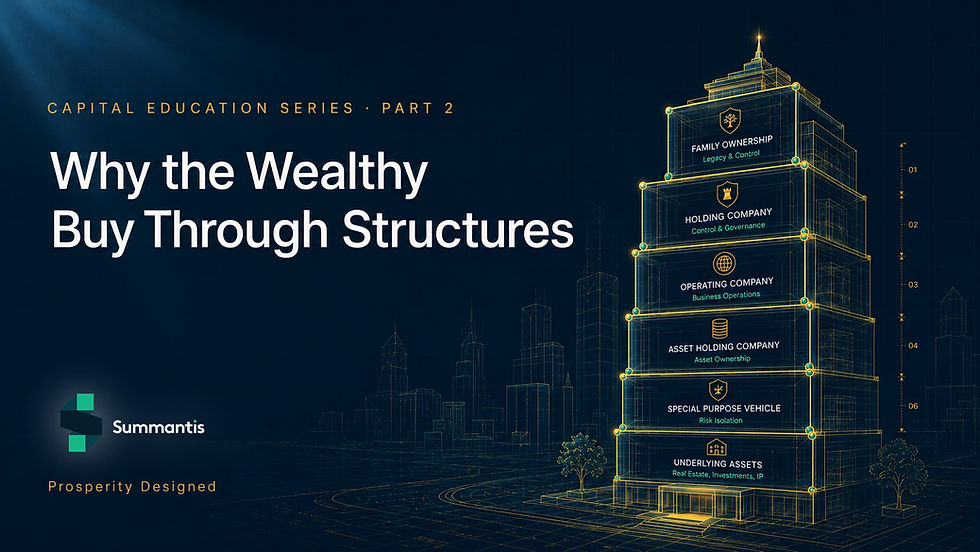
Pull the public records behind almost any significant real estate portfolio and you will rarely find a person's name on the deed. You will find an entity. A limited liability company. A trust. A holding company that quietly owns other companies. To the untrained eye this looks like paperwork — friction the average buyer is glad to skip. To the architect of capital, it is the foundation the entire structure stands on.
The difference between buying an asset and building a portfolio is not the size of the check. It is the structure that receives the asset.
The name on the deed is a design decision
Most people buy in their own name because it is the path of least resistance. The lender is comfortable with it, the escrow officer expects it, and nobody at the closing table is paid to ask a bigger question. So the deed gets signed the same way a personal purchase always gets signed — and a future portfolio is quietly capped before it ever begins.
When you buy personally, you and the asset become the same legal object. Your exposure and the asset's exposure are fused. Every new property you add in your own name stacks onto the same profile, the same risk, the same balance sheet. You are not building a portfolio. You are enlarging a single point of failure.
A structure is not where you hide an asset. It is where you build the system that holds it.
Structure is what makes capital repeatable
A single property held personally is a transaction. A structure built to hold property is a system. That distinction is the whole game.
An entity can carry its own financing, develop its own track record, and build its own relationships with lenders and partners over time. It can hold one asset today and be designed to hold ten. The architecture is what allows the second deal, the fifth, and the twentieth to follow the same blueprint instead of being negotiated from scratch — and renegotiated against your personal limits — every single time.
This is what fundability actually looks like at scale. Capital does not flow to people who simply earn well. It flows to structures that are legible, repeatable, and built to receive it.
Separation is leverage
Hold three properties in your own name and a problem with one can reach across the table to the other two — and to everything else you own. Wealthy buyers design that reach out of existence. Assets are separated so that risk is contained where it lives instead of traveling freely across the whole portfolio.
That separation is not caution for its own sake. It is leverage. When risk is walled off, you can act decisively on the next opportunity — because a single deal going sideways no longer threatens the entire structure you have built.
Structures speak the language of capital partners
The moment you want to bring in a partner, a private lender, or outside investment, a structure gives them something real to underwrite and join. You cannot sell a fraction of “your name.” You can offer a defined stake in an entity — with clear ownership, clear terms, and a clear seat at the table.
This is why serious capital expects to see a structure before the conversation even starts. The entity is the shared language. It is how sophisticated money evaluates a deal, prices its position, and decides whether to deploy. Show up without one and you are not under-prepared — you are speaking a language the room does not transact in.
Build the structure before you need it
The most common and most expensive mistake is sequencing. People find the deal first, fall in love with it, and only then scramble to assemble the structure around a transaction that is already in motion. Built under pressure, the architecture comes out improvised — and improvised architecture is exactly what fails when weight is finally placed on it.
The wealthy reverse the order. The structure is designed first, deliberately, while there is nothing urgent riding on it. By the time the right asset appears, the framework is already standing and ready to receive it. The deal slots into a system that was waiting for it — not the other way around.
Where this goes next. Understanding why structures matter is the entry point to a larger architecture: how holding companies layer ownership so that entities own other entities, and how families turn that layering into a private system of capital. We build those blueprints in the pieces ahead — The Holding Company Blueprint and The Family Bank.
Summantis is an education brand. This article is for general educational purposes and is not legal, financial, or investment advice. Building entities and ownership structures involves legal and financial decisions that vary by situation — work with qualified professionals before acting.
DESIGN THE STRUCTURE FIRST Summantis teaches the capital architecture behind serious portfolios — how structures hold assets, attract capital, and let a single deal become a system. |
Summantis · Prosperity Designed
summantis.com · (661) 213-9152 · Los Angeles, California
This article is published for general educational purposes and does not constitute financial, investment, tax, or legal advice. For guidance tailored to your situation, connect with the Summantis team.

Comments