The Holding Company Blueprint — Supporting Assets

Updated: Jul 14
How the wealthy organize what they own — and why the container matters
as much as the contents

In the first two parts of this series, we examined how capital moves. Equity
recycling showed you how a single dollar of equity can work in more than one
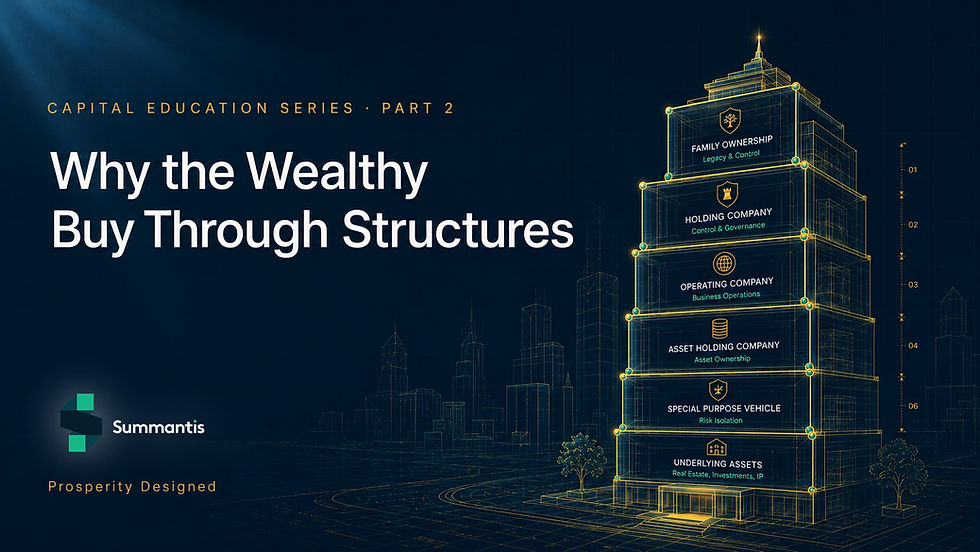
place. “Why the Wealthy Buy Through Structures” showed you why sophisticated
buyers rarely hold assets in their own names. This installment answers the
question those ideas lead to: once you own things through structures, what holds
the structures together?
The answer is the holding company. It is one of the most quietly powerful ideas in
capital architecture, and one of the most misunderstood. Most people picture a
holding company as something reserved for conglomerates and billionaires. In
reality, it is an organizing principle — a way of arranging ownership so that the
assets you build are separated from one another, coordinated from a single point,
and positioned to grow without each one exposing the others.
At Summantis, we teach the holding company not as a product to buy but as a
blueprint to understand. What follows is education, not advice. The goal is to help
you recognize the architecture the wealthy use so you can ask better questions of
the qualified professionals who help you build.
What a holding company actually is
A holding company is an entity that owns other entities. It does not, as a rule, sell
products or deliver services itself. Its job is ownership. Beneath it sit the operating
entities and asset-holding entities — a company that runs a business, an entity that
holds a rental property, another that holds a second property. The holding
company sits above them all and owns them the way a parent owns its children.
Picture it as a family tree drawn upside down. At the top is the parent — the
holding company. Branching below are the subsidiaries, each one containing a
single asset or a single line of activity. Cash, ownership interests, and decisions
flow up and down the tree, but the branches do not touch each other directly. That
separation is the entire point.
The contrast is stark when you compare it to how most people accumulate assets.
The typical path is to buy a rental in your own name, then a second one, then start
a small business, all held personally and tangled together. If one of those assets
creates a problem, every other asset you own is standing in the same room. The
holding company puts each asset in its own room and closes the doors between
them.
Why the container matters as much as the contents
We tell students to think in terms of containers. The asset is the contents. The
entity is the container. Most people spend all their attention on the contents —
which property, which business, which deal — and none on the container. The
wealthy think about both at once, because the container determines what happens
to the contents under pressure.
Three ideas explain why the holding company structure is worth understanding.
The first is separation. When each asset lives in its own subsidiary, a problem
inside one subsidiary tends to stay inside it. A dispute tied to one property does not
automatically reach across to the property held in a different entity. This is a
general principle of how entities are meant to work — the specifics depend heavily
on how the structure is set up and maintained, which is exactly the kind of thing
you confirm with qualified counsel.
The second is coordination. As your holdings grow, decisions multiply. Who owns
what, who gets paid, where cash accumulates, how ownership passes to the next
generation. A holding company gives you a single point of control over many
moving pieces. Instead of managing a scattered collection of assets, you manage
one parent that manages the rest.
The third is continuity. Assets held personally are tied to a person. Assets held
through a structure can outlast the individual and pass according to a plan. The
holding company is the mechanism that lets what you build become something that
continues rather than something that scatters.
The blueprint, one level at a time
Imagine an investor named Marisol. She is illustrative, not real, but her path
mirrors what we see constantly in Central Valley and Inland Empire portfolios.
Marisol starts with one rental property held in a single entity. Simple. Then she
buys a second. Rather than adding it to the first entity, she places it in a second
entity of its own — two containers, two closed doors. Now she has a choice to
make. She can manage two separate entities by hand, or she can form a parent
above them that owns both.
She forms the parent. Her two property entities become subsidiaries of one
holding company. Nothing about the buildings changes. What changes is the
architecture around them. Cash from both properties can be coordinated at the
top. A future third property slots in as a third subsidiary without disturbing the
first two. When she eventually adds an operating business, it becomes another
branch on the same tree — separated from the real estate, coordinated by the
same parent.
This is the blueprint. It is not built all at once. It is built one level at a time, each
entity added deliberately, the structure growing to match the assets rather than
being imposed before there is anything to hold. The mistake we see most often is
the opposite: people wait until their assets are tangled together and only then try
to separate them, which is far harder than building the separation in from the
start.
What the blueprint is not
Because this is education, precision matters. A holding company is not a magic
shield that makes obligations disappear, and it is not a substitute for insurance,
sound operations, or honest dealing. The protections a structure offers depend
entirely on respecting the structure — keeping entities genuinely separate,
maintaining them properly, and never treating the parent and its subsidiaries as
one undifferentiated pocket of money.
It is also not a decision to make from a blog post. Whether a holding company fits
your situation, what form it should take, and how it should be set up are questions
for qualified legal and financial professionals who know your specific
circumstances. What we teach you here is the shape of the thing so that when you
sit across from those professionals, you are speaking their language and asking the
right questions.
The pattern beneath the wealth
Return to where this series began. Capital is not the problem. Structure is the
problem. The holding company is where that principle becomes concrete. It is the
architecture that lets equity recycle, lets ownership sit inside protective
containers, and lets a collection of individual assets become a coordinated whole.
The wealthy do not build one asset at a time and hope it adds up. They build a
structure and let the assets fill it. The holding company is the frame that structure
hangs on. Understand the frame, and you begin to see wealth the way it is actually
organized — not as a pile of things owned, but as a blueprint, drawn deliberately,
one level at a time.
N E X T I N T H E S E R I E S
In the next installment, we take the blueprint one step further into the idea that has organized family wealth for generations: The Family Bank.
Summantis · Prosperity Designed
summantis.com · (661) 213-9152 · Los Angeles, California
This article is published for general educational purposes and does not constitute financial, investment, tax, or legal advice. For guidance tailored to your situation, connect with the Summantis team.

Comments