What Is Cost Segregation — And Why 2026 Is the Best Year in a Decade to Use It

Updated: Jul 14
Most real estate investors think of depreciation as a formality — a small deduction their CPA handles quietly in the background. For years, that assumption was mostly correct. In 2026, it's an expensive one.
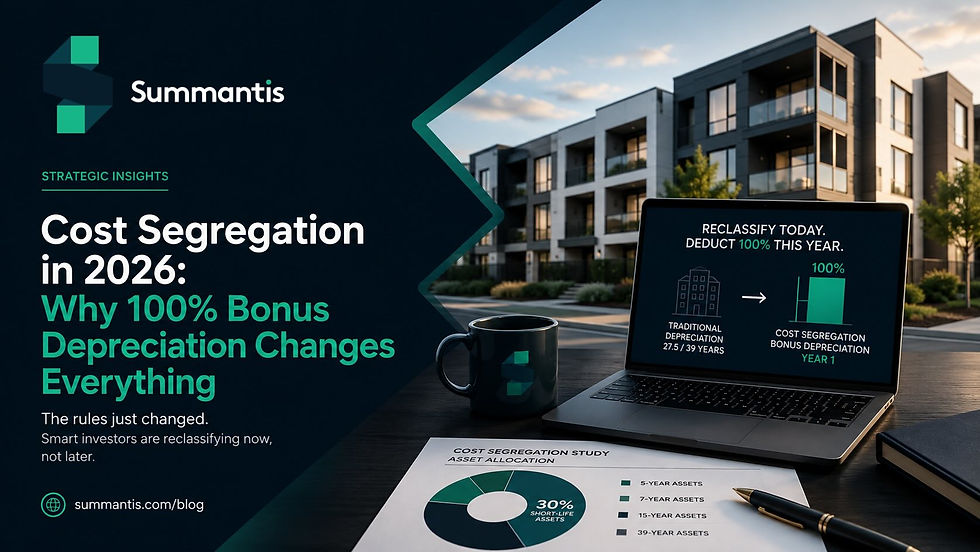
Here's why. Under standard IRS rules, a residential rental depreciates over 27.5 years and a commercial property over 39. Own a $750,000 fourplex, and your CPA writes off roughly $27,000 a year — not nothing, but not the kind of number that changes your strategy either.
Cost segregation changes the math entirely. It's an engineering-based study that breaks a property down into its actual components — the roof, the flooring, the cabinetry, the parking lot, the landscaping, the HVAC — instead of treating the whole building as one asset. Anything with a useful life of 20 years or less gets reclassified into a 5-, 7-, or 15-year category. That reclassification is the unlock: shorter-life assets qualify for bonus depreciation. The building shell doesn't. Skip the study, and none of that acceleration is available to you, no matter what the tax code allows.
Why now, specifically
For most of the last decade, bonus depreciation was on a slow walk toward irrelevance — 100% under the 2017 tax law, then phasing down year by year, scheduled to hit 20% in 2026 and disappear entirely in 2027. A lot of investors reasonably concluded a cost segregation study wasn't worth commissioning for a shrinking benefit.
That calculus reversed in July 2025. The One Big Beautiful Bill Act permanently restored 100% bonus depreciation for qualifying property acquired and placed in service after January 19, 2025 — no phase-down, no sunset. The IRS followed up in January of this year with Notice 2026-11, clarifying how the acquisition and placed-in-service rules apply. The net effect: every dollar a cost segregation study reclassifies into a short-life category can potentially be written off in full, in year one, right now.
Go back to that $750,000 fourplex. A properly performed study typically identifies 20–35% of the purchase price as short-life property. On the low end, that's roughly $150,000 reclassified — and under current rules, fully deductible in year one instead of trickling out over decades. That's the difference between a deduction you barely notice and one that materially changes your tax bill, your cash flow, and what you're able to do with the capital you free up.
Who this actually makes sense for
Cost segregation isn't universal, and it isn't free — studies typically start in the low thousands, and the value depends heavily on your income, your bracket, and how the property is held. It tends to matter most for:
Investors in higher tax brackets, where accelerated deductions offset income taxed at the highest rates. Owners who qualify for Real Estate Professional status, or who materially participate in a short-term rental, since both open the door to using these losses against active income rather than being limited to passive gains. And anyone acquiring — or who recently acquired — a property after January 19, 2025, since that date determines which set of rules applies.
If you're holding a smaller property for the long haul with no near-term acquisition or refinance plans, the math may not justify the study cost. That's a conversation worth having before you commission one, not after.
The part that matters beyond the tax return
Depreciation is a non-cash deduction, but the cash flow it frees up is real. And freed-up cash flow isn't just a tax outcome — it's capital. It's what funds the next down payment, pays down higher-cost debt, or gets redeployed into the next acquisition. Read alongside our pieces on equity recycling and capital stacking, cost segregation isn't a standalone trick — it's one more lever in the same machine: using what you already own more efficiently, so your capital moves instead of sitting still.
This isn't personalized tax advice, and it shouldn't be treated as a substitute for a conversation with a CPA who knows your full picture. What it is: a strategy worth understanding before your next acquisition or your next tax season, whichever comes first — because the rules just got a lot more favorable, and most investors don't yet know it.
If you're evaluating a property, sitting on one you haven't optimized, or simply want a second set of eyes on your portfolio's depreciation strategy, that's exactly the kind of conversation a 30-minute consultation is for.
Summantis · Prosperity Designed
summantis.com · (661) 213-9152 · Los Angeles, California
This article is published for general educational purposes and does not constitute financial, investment, tax, or legal advice. For guidance tailored to your situation, connect with the Summantis team.



Comments