The 45-Day Problem: Why Most 1031 Exchanges Are Won or Lost Before the Listing Goes Up

Estimated read: 7 min

Consider a sequence that plays out every quarter in California.
An investor sells a stabilized fourplex in the Central Valley. Everything on the paperwork is correct. A qualified intermediary is engaged before escrow opens. Counsel has reviewed the assignment language. The CPA has modeled the deferral down to the dollar and the number is significant enough to change the shape of the next decade.
Escrow closes in late September. The investor begins looking for a replacement property in early October.
Six weeks later, the identification window closes. Three properties go on the list because three is what the rule allows and three is what was available. One is overpriced. One has a tenant issue nobody had time to diagnose. The third goes under contract with a cash buyer on day 62.
The exchange fails. The tax liability that was supposed to defer across a generation arrives the following April.
Nothing in that sequence was illegal, careless, or unlucky. It was simply built in the wrong order. And the wrong order is the single most common reason exchanges fail — not the tax code, not the intermediary, not the market.
The clock does not start when you start looking
The mechanics are widely published and almost universally misread.
Day zero is the day escrow closes on the property you sell. From that moment, you have 45 calendar days to identify replacement property in writing to your qualified intermediary, and 180 calendar days to take title.
Those two windows do not run back to back. They run at the same time. You do not get 45 days and then 180 days. You get 45 days, and then whatever remains of the original 180 — roughly 135 days — to complete underwriting, diligence, and closing on a property you may have first walked three weeks earlier.
Weekends and federal holidays do not extend either deadline. There is no hardship provision and no discretionary extension.
There is also a second deadline hiding inside the first one, and it catches a meaningful number of sellers every year. The replacement property must be received within 180 days or by the due date of the tax return for the year the relinquished property was sold — whichever comes first. For a sale that closes in mid-October, 180 days lands somewhere near the ordinary April filing deadline. An investor who files on time rather than filing an extension can quietly forfeit weeks of the window.
That is a calendar decision made in October about a form filed in April. It is not a tax question. It is a sequencing question, and it belongs on the timeline before the property is ever listed.
Identification is narrower than it looks
Three identification standards are available, and in practice most investors use the first:
The three-property rule. Identify up to three replacement properties, at any value, and acquire one or more of them.
The 200% rule. Identify more than three, provided the combined fair market value of everything on the list does not exceed 200% of what the relinquished property sold for.
The 95% rule. Exceed both limits, and you must acquire at least 95% of the aggregate value identified. In practice this is a rule most investors read once and never use.
Default to three, and you have three shots. If one falls out of contract in week nine and the other two were placeholders assembled under deadline pressure from whatever happened to be listed that month, the exchange is over. Not because the rule is unreasonable, but because the list was never real. A backup that cannot actually be financed, permitted, or closed is not a backup. It is a line on a form.
Which makes this a sourcing problem, not a tax problem
Forty-five days is not much time to find quality replacement inventory in California — and you are shopping with your position disclosed.
Every listing agent in the state can identify an exchange buyer within one conversation. A motivated buyer on a legally fixed deadline is the weakest negotiating position in real estate. It shows up in price. It shows up in which contingencies survive. It shows up in who pays for what after inspection.
This is precisely where off-market access stops being a convenience and becomes structural. Inventory that is not being bid by six other parties gives an exchange buyer the one thing the calendar has taken away: the ability to walk. We have written before about where sophisticated capital actually buys — the exchange window is the clearest case for why those relationships are built long before they are needed.
The investors who complete exchanges cleanly are almost always the ones who were looking at replacement inventory for months before they listed anything. Not because they knew their sale date, but because they had a pipeline. They had underwritten deals they did not buy. They knew which submarkets they would take and which they would not. When day zero arrived, identification was a decision, not a search.
The financing clock runs in parallel
One hundred and eighty days sounds generous until it is measured against underwriting.
A commercial or DSCR loan on an investment property typically runs 30 to 60 days from a complete file — longer with an appraisal backlog, an environmental review, tenant estoppels, or an entity structure the lender has not seen before. Start that process on day 50 and the margin for a single surprise is thin.
Then there is the structural requirement most investors underestimate. To defer the full gain, the general standard is that the replacement property must be equal to or greater in value than the property relinquished, all net equity must be reinvested, and the debt retired must be replaced at an equal or greater level — or made up with additional cash out of pocket. Any shortfall is boot, and boot is taxable in the year of the exchange.
Read that again as a capital question rather than a tax one. The exchange sets a floor on your capital stack before you have chosen a property. How much debt you need to carry, on what terms, at what coverage ratio, held in which entity, backed by which guarantor — those are architecture decisions, and the exchange imposes them on you in advance.
Entity structure deserves particular attention here. Title to the replacement property generally must be taken by the same taxpayer that relinquished the original. Forming a fresh LLC to hold the new asset — an instinct that is otherwise sound, and one we have written about at length — can compromise the exchange if it is done at the wrong point in the sequence.
The lender conversation, the term sheet, and the titleholding structure belong in the 60 to 90 days before listing. Not week seven.
When the calendar will not cooperate
Two structures exist specifically because sequencing is the binding constraint.
A reverse exchange parks the replacement property with an exchange accommodation titleholder so the purchase happens before the sale. It removes the sourcing scramble entirely. It also costs more, requires either cash or a lender willing to work with the accommodation structure — a narrower group than the general market — and still operates within a 180-day safe harbor.
An improvement exchange allows exchange proceeds to fund construction on the replacement property while it is held by the accommodator, with improvements needing to be completed within the window to count toward replacement value.
Both are more expensive and more complex than a standard forward exchange. Both are worth understanding well before the day you need one, because neither can be assembled quickly.
Deferral is not the end of the design
Two items matter after the exchange closes, and both are routinely treated as afterthoughts.
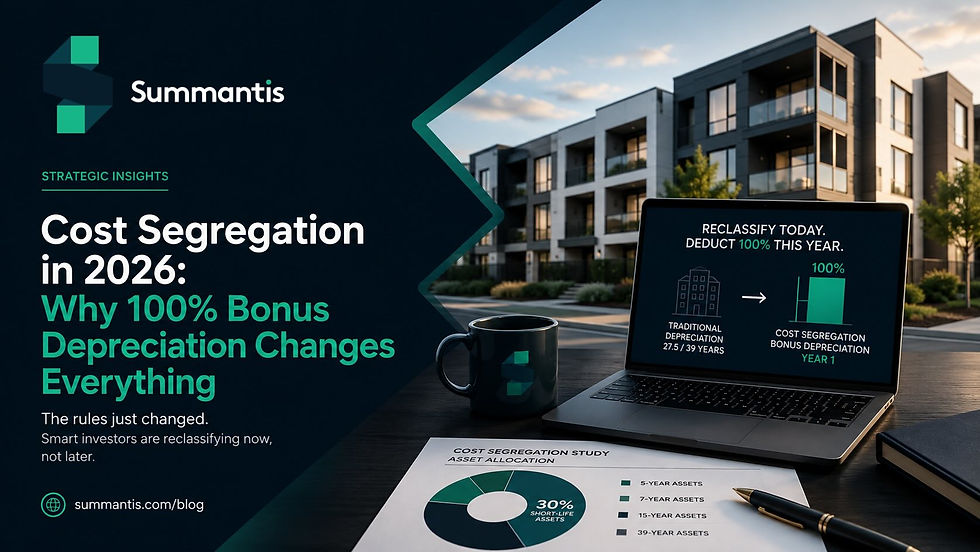
The depreciation question carries forward. Basis in an exchange is carryover basis, which makes the analysis more layered than it is on an ordinary purchase — the treatment of carryover basis and any excess basis from new money differs. But where an investor brings additional capital into the replacement property, a cost segregation study can still accelerate meaningful deductions, particularly with 100% bonus depreciation now permanently restored for qualifying property. We covered that shift in detail in our piece on cost segregation. Note that this is a federal benefit; California has never conformed to bonus depreciation, and the state schedule runs separately.
California does not let go. Exchange a California property into replacement property in another state and the federal deferral works exactly as expected — but California tracks the California-source gain and requires an annual information return, FTB Form 3840, filed every year until that gain is ultimately recognized. The obligation continues even if you relocate, and even if you exchange the replacement property again. Investors frequently treat it as a one-time filing in the year of the exchange. It is not, and the penalties compound quietly across years.
For a California-based investor moving capital out of state, this is not a reason to stay. It is a reason to plan the exit and the reporting tail at the same time.
On the policy question
Section 1031 remains available for real property held for investment or business use. Personal property was removed from its scope under prior legislation and has not returned. Proposals to cap annual deferral surface periodically in budget discussions — a proposed cap circulated recently and was not enacted.
The useful posture is not to guess. It is to build a portfolio where a change to any single provision is an adjustment rather than a crisis. A strategy that only works while one section of the tax code survives untouched is not a strategy. It is a bet.
Reordering the sequence
The version that fails looks like this: list, sell, search, scramble.
The version that works starts roughly 90 days earlier.
90 to 60 days before listing. Define replacement criteria — asset type, submarket, minimum coverage, target hold. Begin underwriting live inventory you have no obligation to buy.
Same window. Open lender conversations and secure indicative terms. Confirm the titleholding entity matches the relinquishing taxpayer.
Before escrow opens. Engage the qualified intermediary. Proceeds cannot pass through your hands, and constructive receipt ends the exchange before it starts.
Build a live pipeline of five to eight genuine candidates, including off-market relationships, so that day one begins with a real list rather than a search.
If closing lands in the fourth quarter, decide the extension question then — not in April.
Days 0 through 45. Narrow, tour, negotiate, and identify with backups that could actually close.
Days 45 through 180. Underwrite, close, and immediately turn to depreciation planning and, where applicable, the California reporting obligation.
A 1031 exchange is not a form filed at the end of a transaction. It is a sequence, and the expensive work happens before the clock starts. By the time day zero arrives, the outcome is largely already determined.
That is what makes it an architecture problem — which is the only kind of problem we know how to solve.
Planning a disposition in the next two quarters? The most valuable conversation happens before the property is listed, while sourcing, financing, and structure can still be arranged in the right order. Schedule a consultation with the Summantis team.
This article is provided for educational purposes only. Timelines, identification standards, and reporting obligations described here are general in nature and depend on the specific facts of a transaction. Any figures or scenarios referenced are illustrative. Consult a qualified intermediary, tax professional, and legal counsel regarding your own circumstances before entering into an exchange.


Comments