The Family Bank

C A P I T A L E D U C A T I O N S E R I E S · P A R T 4 · F I N A L E
How families turn scattered money into a system that outlasts them — and lends to its own
This series began with a single idea: capital is not the problem, structure is the problem. We traced that idea through three movements. Equity recycling showed how one dollar can work in more than one place. “Why the Wealthy Buy Through Structures” showed why serious buyers hold assets through entities rather than in their own names. “The Holding Company Blueprint” showed how those entities are organized under a single parent. This final installment answers the question the whole series has been building toward: once a family has structure, capital, and coordination, what does it do with them across time?
It builds a family bank.
The family bank is not a building, a charter, or a licensed institution. It is a way of thinking about family capital as a system rather than a pile — money that is pooled, governed, and lent to its own members and ventures instead of scattering outward and never returning. It is the oldest idea in this series and the most powerful, because it is the one that turns wealth from something a person has into something a family keeps.
At Summantis, we teach the family bank as a concept to understand, not a product to purchase. What follows is education, not advice.
The idea in one sentence
A family bank is what you get when a family decides to be the source of its own capital.
Consider how capital normally flows through a family. A child needs money to start a business, buy a first property, or fund an education. They go outside the family — to a lender, an investor, a bank — and they pay for that capital. The interest, the fees, the returns all flow out of the family and into someone else’s system. The money leaves and does not come back.
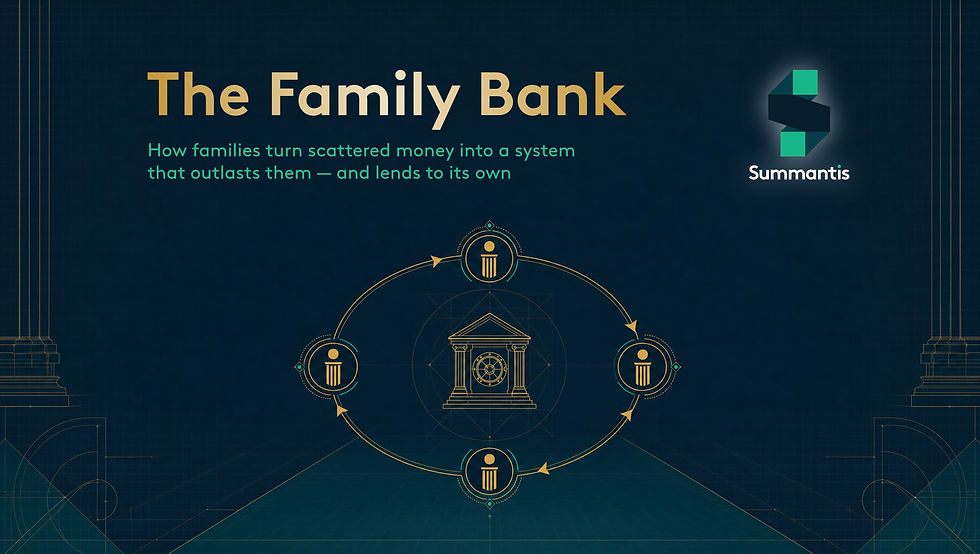
The family bank reverses that flow. Instead of every member sourcing capital from outside, the family builds a coordinated pool and becomes the lender. When a member needs capital for a venture the family believes in, that capital comes from inside the system, on terms the family sets, and the returns flow back into the same pool rather than out to a stranger. The family becomes the institution its own members borrow from.
This is not about generosity, and it is not about handing money to relatives. It is the opposite — it is about discipline. A family bank works precisely because it operates like a bank: with structure, with terms, with expectations, and with a governing logic that outlasts any single decision.
Why it completes the blueprint
Everything earlier in this series was preparation for this. The family bank does not replace the holding company, the entities, or the recycled equity — it sits on top of them and gives them a purpose that reaches beyond one lifetime.
Recall the three ideas from the holding company: separation, coordination, and continuity. The family bank is what continuity looks like when it is fully expressed. A holding company can coordinate assets today. A family bank coordinates capital across generations. It is the mechanism by which the structure you build stops being about you and starts being about the line of people who come after you.
Think again about equity recycling. A single dollar working in more than one place is powerful. A family bank is that same principle raised to the level of a bloodline — capital that recycles not just across deals but across people and decades, funding one member’s real estate, then another’s business, then a grandchild’s first venture, the same pool turning over and over inside the family.
That is why we place it last. The family bank is where the individual techniques of this series converge into a single system designed to endure.
What it looks like in practice
Return to Marisol, the illustrative investor from the previous installment. She built a holding company above her properties and her business. She is now the coordinator of a real, if modest, structure. The family bank is her next question: not how do I grow my assets, but how does this become something my family draws on after me?
In concept, she begins to treat the capital her structure generates as a governed pool rather than personal spending money. When her nephew wants to buy his first investment property, he does not go straight to an outside lender and pay full freight to a stranger. He comes to the family pool with a plan, on terms the family has agreed to in advance, and the returns he generates flow back into the pool for the next member. The capital never left the family. It circulated.
Over time, the family bank develops what every institution needs: rules about who can draw on it, what standards a request must meet, how decisions are made, and how the pool is protected from being drained by any one member. Those rules are the difference between a family bank and simply lending money to relatives. Without governance, it is a favor. With governance, it is a system.
What the family bank is not
Precision matters most here, because this concept sits close to areas that require licensed professionals. A family bank, as we teach it, is an organizing principle for how a family thinks about and governs its own capital. It is not a specific financial product, a licensed lending institution, an insurance strategy, or an estate or tax plan. We are not describing a vehicle to buy or a scheme to implement — we are describing a way of thinking about capital as a family system.
The moment a family moves from concept to implementation — actual entities, actual lending, actual movement of money between members — it enters territory that involves real legal, regulatory, and financial considerations that vary enormously by circumstance and jurisdiction. Those are questions for qualified, licensed professionals who know the family’s specific situation. What we give you here is the shape of the idea so that when you sit with those professionals, you understand what you are trying to build.
The end of the series, the beginning of the structure
We have arrived where the series was always headed. Capital is not the problem. Structure is the problem — and the family bank is structure carried to its natural conclusion. It is the point at which recycled equity, protective entities, and a coordinating holding company stop being tools for building wealth and become a system for keeping it.
The wealthy do not think in terms of what they can accumulate in a lifetime. They think in terms of what they can build that continues. A family bank is that ambition made structural: a family that becomes the source of its own capital, governs it with discipline, and passes down not just money but the architecture that keeps money working.
That is the whole of what this series has tried to teach. Not a set of tricks, but a way of seeing. Wealth is not a pile of things owned. It is a structure, built deliberately, one level at a time — and at the top of that structure, when it is built to last, sits a family that banks on itself.
SERIES COMPLETE The Capital Education Series: Equity Recycling → Why the Wealthy Buy Through Structures → The Holding Company Blueprint → The Family Bank. |
Summantis · Prosperity Designed
summantis.com · (661) 213-9152 · Los Angeles, California
This article is published for general educational purposes and does not constitute financial, investment, tax, or legal advice. For guidance tailored to your situation, connect with the Summantis team.



Comments